|
LOWTHER - THE COMMANDING VOICE OF QUALITY
The type of loudspeaker
drive unit upon which Lowther's reputation has held pride of place
for many decades, grew from the twin-cone units invented by P.A.G.H.
Voigt. At the same time two sound- engineers, Rice and Kellog, were
designing single cone drive units, a pattern which has served for a
very long time in meeting listening requirements. However, when the
very best possible standards of reproduction were wanted, it was to
the twin-cone unit that the experts invariably turned. Oddly enough,
patents for both these types of units were lodged within two weeks
of each other.
In the mid-1930's , moving-coil loudspeakers,
which were rapidly growing in popularity, used a mains energized
coil to produce the required magnetic field. To ensure optimum
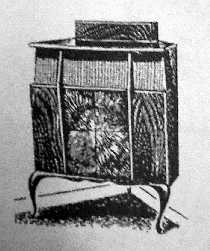
quality from the unit he had designed, Voigt coupled it to a horn
loaded system embodying a tractrix formation - again both examples
of Voigt's inventive approach to new loudspeaker designing.
Today such loudspeakers are very much sought
after, not only on account of their undoubted historical value, but
even more so for the excellent sound quality they offer to this very
day.
Just prior to 1939, Donald Maynard Chave joined
forces with Voigt on what today we would call R & D (Research
and Development). Chave, whose name was eventually to become a
by-word the world over, for the very best in sound reproduction,
became responsible for the design of permanent magnets to replace
the old wound-coil methods previously used.
Our original horn loaded designs were created in
the main by Voight. He firmly believed that the audio spectrum
should be covered by a single speech coil source. Lowther has never
deviated from that principle, believing that reproduced sound lacks
a degree of life when electronic filters are used.
Donald Chave, the founder member of Lowther,
continued the design philosophy, modifying and improving our systems
wherever new techniques and materials allowed. Mr. Chave remained
with us until his demise in 1985.
Our present Logic Series and Fidelio Series ranges
are completely original, based on the balancing of two finely tuned
air columns (the Bicor system). A problem in the past has been the
necessity to have large cabinets in order to create the smooth bass
response that only a horn can give.
H.F. Olson, and many other Acoustic engineers,
have shown in their writings that when the mouth area and length of
horn is reduced, sound waves reflect back towards the throat and
create standing waves. The Bicor systems eliminate this completely
by allowing such reflected sound waves to pass through the first air
column, and to pass out of the cabinet through the second column. By
finely tuning the opposed internal pressures, we are able to add to
the control of the speech coil, over and above that created by the
magnetic damping provided by the very powerful magnet systems we
use. By this method, we keep the generation of back electromotive
force to a minimum. Back EMF is a problem inherent in long throw
drive units which is normally overcome by using more power and often
relying upon the amplifier to assist in the damping control. A
further advantage of keeping the speech coil within the gap area is
that heat dissipation is allowed through the ironwork of the magnet
system allowing adequate power handling, which in conventional
systems is carried out within the cross over circuitry.
The cones are made of a cartridge paper especially
produced for us. These cones are treated with a compound in order to
eliminate uncontrolled cone breakup. During the initial 50 or
60 hours listening time, this unit will continue to improve to a
level that makes the midrange response unparalleled by any other
unit. During this 'running' in time, the cone surfaces will break
up, in a controlled manner, into millions of separate areas. As the
frequency response climbs these breakup areas increase in quantity
but progressively reduce in size.
Each model in the latest range, (the ‘EX'
Series), incorporates an acoustic chamber precisely tuned for
optimum performance. Cone assemblies are pressure balanced between
the acoustic chamber at the rear and a phasing equalizer fitted to
the front. No unwanted oscillations of the speech coil occur. Only
bass frequencies will pass through the acoustic chamber, so avoiding
bass/mid-range confusion, often a cause of coloration.
At the top end of the frequency range, the inner
speech coil itself breaks up into individual areas producing the
high frequencies of this unit. In order to allow this to happen we
have designed our own adhesive that remains flexible throughout
their life, yet firmly hold the speech coil, which is of aluminum
wire to the former. A further complication we had overcome was to
produce an adhesive that would withstand temperatures of 180
centigrade. In all, three separate adhesives are used on the coil.
Our back centering device is not the conventional
fabric type as this would allow air to pass between the weave of the
fabric. The horn would then transfer this into very audible sound at
its mouth. Both the centre and surround are of the lightest possible
material but treated with a compound to give maximum control. The
complete diaphragm assembly with suspensions weigh a mere 11 grams
including air load. (Incidentally, each piece is weighed on
assembly, in order that variation between units is kept to an
absolute minimum).
We guarantee our drive units for
1 years. It is
however, unusual to see them back in our factory in under 10 years
of use, except where Lowther enthusiasts have upgraded using our
exchange scheme to take advantage of the new developments in sound
reproduction that we constantly strive to achieve.
|